AI Server Rack Setup: How a ₹3.5 Lakh Investment Turned into a High-Performance AI Business
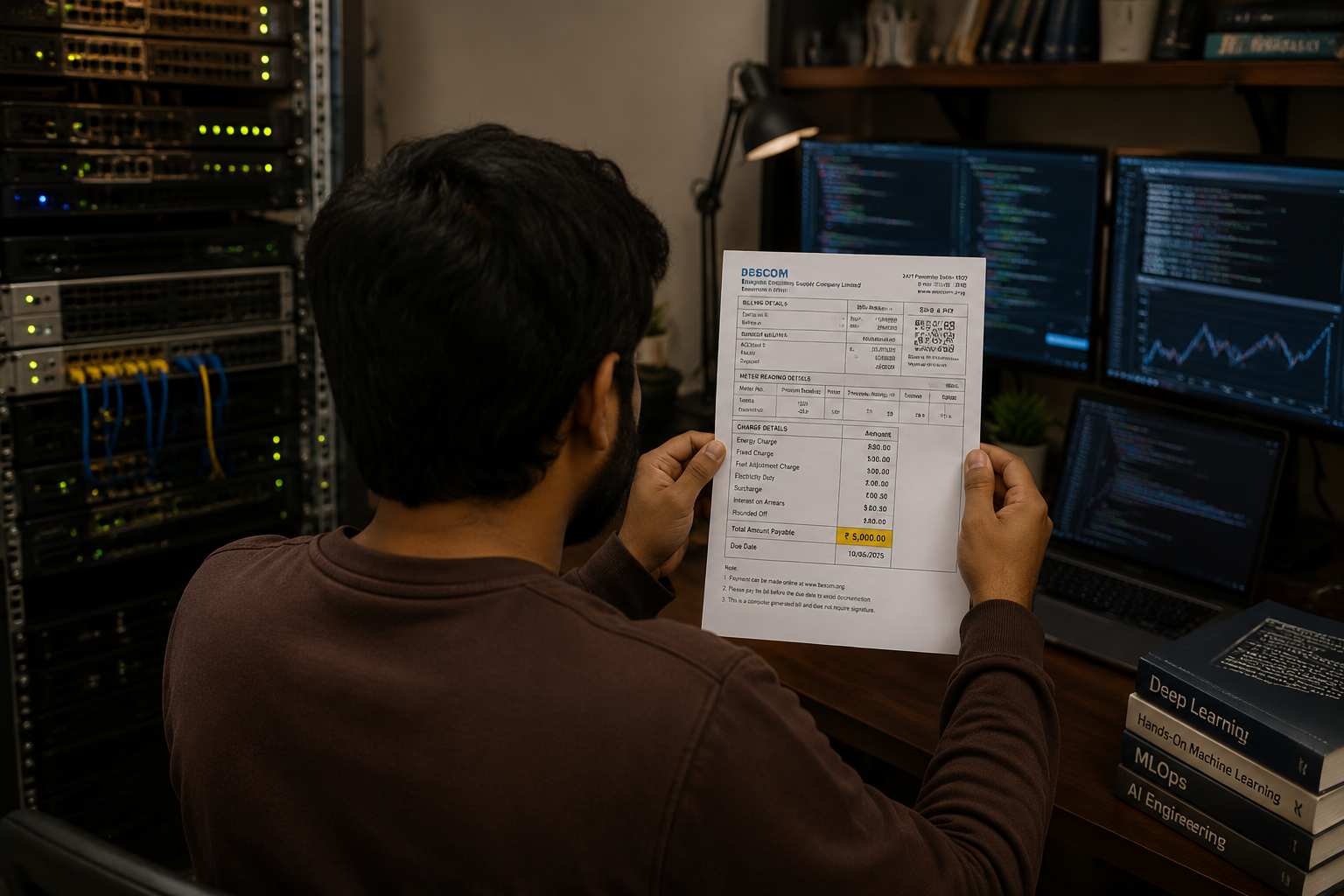
Discover how a developer transformed a ₹3.5 lakh enterprise server purchase into a powerful AI workstation capable of fine-tuning large language models while minimizing cloud costs.
AI Server Rack Setup: Can a ₹3.5 Lakh Investment Replace Expensive Cloud GPUs?
Artificial Intelligence is changing how software is built, deployed, and scaled. Every day, developers spend thousands of rupees on cloud GPUs to train and fine-tune AI models. But what if there was another way?
Imagine buying enterprise-grade hardware for a fraction of its original cost, building your own AI infrastructure at home, and eliminating recurring cloud expenses.
A widely shared story in the AI community describes how a Bangalore developer reportedly transformed a decommissioned enterprise server setup into a powerful AI workstation capable of handling large-scale model fine-tuning. While this story should be viewed as an illustrative case study rather than a verified report, it highlights an important trend—enterprise hardware auctions are opening new opportunities for developers, startups, and AI enthusiasts.
Let's explore how this type of AI server rack setup works and why it has become an attractive alternative to expensive cloud computing.
Why Developers Are Building Local AI Infrastructure
Over the last few years, AI development has become increasingly dependent on cloud services.
Platforms like AWS, Azure, and Google Cloud provide powerful GPUs, but they also come with recurring expenses including:
GPU hourly charges
Storage costs
Bandwidth charges
API limitations
Usage quotas
For individuals training large language models every day, these expenses quickly add up.
This is why many AI engineers are now exploring local AI infrastructure, allowing them to own the hardware instead of renting computing power.
The ₹3.5 Lakh AI Server Story
According to the widely circulated case study, a 27-year-old developer purchased a decommissioned enterprise server rack from a government IT auction.
The reported purchase included enterprise hardware that originally cost significantly more when new, including:
Enterprise storage shelves
High-capacity hard drives
Managed networking equipment
Rack-mounted infrastructure
Instead of using it as a traditional storage server, the developer reportedly transformed the setup into an AI workstation by integrating modern GPU systems beneath the desk.
Although the exact financial figures have not been independently verified, the story demonstrates an important concept:
Enterprise hardware retains significant value long after organizations retire it.
Why Enterprise Servers Are So Cheap at Auctions
Large organizations frequently replace their IT infrastructure every few years.
Banks
Insurance companies
Government offices
Universities
Telecommunication companies
Large corporations
often sell older equipment through government auctions or certified disposal programs.
The equipment may no longer meet enterprise requirements, but it remains extremely capable for:
AI development
Data storage
Home labs
Virtualization
Machine learning
Local cloud infrastructure
For developers willing to learn, these auctions can provide exceptional value.
Building an AI Server Rack Setup
A modern AI workstation usually combines enterprise hardware with consumer GPUs.
A typical setup may include:
Enterprise Rack
Provides:
Storage
Networking
Cooling
Power management
GPU Workstation
Modern graphics cards such as RTX 3090 or RTX 4090 perform AI computation.
These GPUs are commonly used for:
Fine-tuning LLMs
Image generation
Stable Diffusion
Computer vision
AI inference
Large Storage
Training datasets require enormous storage capacity.
Enterprise drives offer:
Reliability
High endurance
Massive storage
Perfect for AI datasets.
Fast Networking
Managed switches help move data efficiently between systems while supporting multiple machines simultaneously.
Fine-Tuning Large Language Models
Instead of creating AI models from scratch, developers often fine-tune existing open-source models.
Popular examples include:
Llama
Mistral
Qwen
Gemma
Fine-tuning allows developers to specialize models for:
Healthcare
Finance
Customer support
Education
Coding assistants
Regional languages
This significantly reduces training costs.
Why Local AI Infrastructure Is Becoming Popular
Cloud GPUs are convenient.
But owning hardware provides several advantages.
No Hourly Billing
Cloud providers charge by the hour.
Local infrastructure runs whenever you need it.
Complete Privacy
Sensitive datasets remain on your own hardware.
This is especially important for businesses handling confidential information.
Unlimited Experimentation
Developers can:
train repeatedly
test new models
benchmark systems
without worrying about hourly costs.
Long-Term Savings
While hardware requires an upfront investment, continuous AI workloads often become less expensive over time compared to renting cloud GPUs.
What About Electricity Costs?
One of the most interesting aspects of the story was the reported electricity bill.
Instead of paying thousands of dollars for cloud GPUs, the developer reportedly operated the local infrastructure using standard residential electricity.
Actual costs will vary depending on:
GPU models
Workload intensity
Electricity tariffs
Cooling requirements
Operating hours
Nevertheless, local infrastructure can significantly reduce recurring cloud expenses for certain AI workloads.
Can Individuals Really Compete with Large AI Companies?
Not entirely.
Companies like OpenAI, Anthropic, Google DeepMind, and Meta operate thousands of GPUs simultaneously.
However, independent developers no longer need massive data centers to build valuable AI products.
Today, individuals can:
Fine-tune models
Build AI SaaS tools
Develop AI chatbots
Offer AI consulting
Create domain-specific assistants
Train custom business models
All from relatively compact hardware setups.
Government IT Auctions: A Hidden Opportunity
Every year, organizations retire large quantities of enterprise hardware.
Developers often overlook these opportunities because they assume older hardware has little value.
In reality, many components remain highly capable.
Potential sources include:
Government surplus auctions
Bank IT refresh programs
Enterprise liquidations
Corporate asset sales
University surplus equipment
Before purchasing, buyers should verify:
Hardware condition
Power consumption
Replacement part availability
Warranty status
Shipping costs
Is This Approach Right for Everyone?
Not necessarily.
Local AI infrastructure requires:
Hardware knowledge
Networking basics
Linux administration
GPU configuration
Storage management
Backup planning
Cloud platforms remain the easiest option for beginners.
However, experienced developers working on continuous AI projects may benefit from investing in their own infrastructure.
The Future of AI Development
The AI industry is moving toward open-source innovation.
Powerful models are becoming increasingly accessible.
Affordable GPUs continue improving.
Enterprise hardware is readily available.
As a result, more developers are building independent AI labs from their homes, garages, and small offices.
The barrier to entry is lower than ever before.
Key Takeaways
This case study highlights several important lessons:
Enterprise hardware can remain valuable long after organizations retire it.
Local AI infrastructure can reduce dependency on cloud computing.
Open-source language models have lowered the cost of AI development.
Government IT auctions may offer affordable hardware opportunities.
AI entrepreneurs increasingly combine enterprise equipment with modern GPUs to build capable workstations.
Whether you're an AI researcher, startup founder, or machine learning enthusiast, understanding how to build an AI server rack setup could become a valuable long-term investment.
Frequently Asked Questions
Is buying enterprise servers worth it?
Yes, if you understand server hardware and plan to use it extensively. Enterprise systems often provide excellent value for AI, storage, and virtualization projects.
Can RTX 3090 still train AI models?
Yes. The RTX 3090 remains a popular choice for fine-tuning many open-source language models thanks to its 24 GB of VRAM.
Are government IT auctions safe?
Many government and enterprise auctions are legitimate, but buyers should inspect equipment carefully, understand the auction terms, and account for refurbishment costs.
Can I run Llama models locally?
Yes. Depending on the model size and your hardware configuration, many Llama variants can be run or fine-tuned locally using modern GPUs.
Is local AI infrastructure cheaper than cloud computing?
For continuous, long-term workloads, owning hardware can be more cost-effective. For occasional use or short-term experiments, cloud services may still be the better option.
Conclusion
Building a personal AI infrastructure is no longer limited to large technology companies. With the right combination of enterprise hardware, modern GPUs, and open-source AI models, developers can create powerful systems capable of supporting real-world machine learning projects. While stories of exceptional earnings should be treated as illustrative unless independently verified, the broader lesson remains clear: affordable enterprise hardware and open-source AI have made advanced development more accessible than ever.
Share this post