Skills vs Projects: What Helps You Stand Out in Today's Competitive Tech Market?
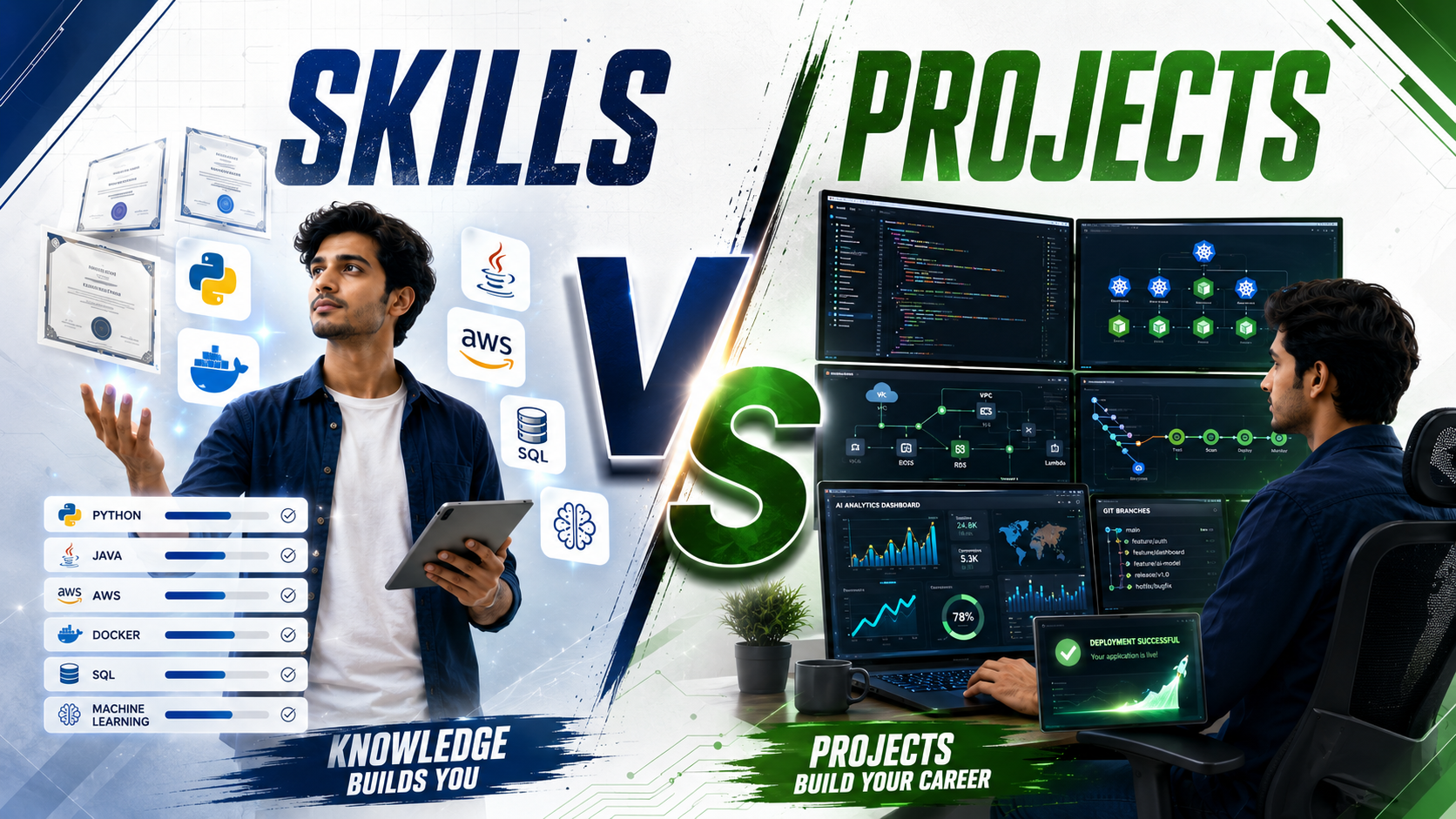
Wondering whether skills or projects matter more in today's tech industry? Learn why practical projects, problem-solving, and continuous learning are the key to standing out in a competitive technology market.
Skills vs Projects: What Helps You Stand Out in Today's Competitive Tech Market?
The technology industry has never been more competitive. Every year, thousands of graduates, career switchers, and experienced professionals enter the job market with similar certifications, online course completions, and technical skills listed on their resumes.
This raises an important question:
What actually makes someone stand out in today's competitive tech market?
Is it the number of programming languages you know? Or is it the projects you've built?
The reality is that employers are increasingly looking beyond certificates and resumes. They want candidates who can apply their knowledge to solve real-world problems. While technical skills remain essential, practical projects are often what separate an average candidate from an exceptional one.
Let's explore why.
Why Skills Alone Are No Longer Enough
Learning programming languages and frameworks is the first step in any technology career. Whether it's Python, Java, JavaScript, React, or AWS, these skills form the foundation of your knowledge.
However, there's one challenge:
Thousands of candidates learn the exact same technologies.
If everyone knows Python or React, employers need another way to evaluate candidates. This is where practical implementation becomes important.
Knowing a concept is different from using it to solve real business problems.
Example
- Knowing React is a skill.
- Building an e-commerce website using React demonstrates practical experience.
The second example provides measurable proof of your abilities.
Why Projects Make a Stronger Impression
Projects show that you can convert theoretical knowledge into working solutions.
Instead of simply claiming you know a technology, you're demonstrating it.
When recruiters review portfolios or GitHub repositories, they gain insight into:
- Your coding practices
- Problem-solving approach
- Software architecture decisions
- UI and UX thinking
- Documentation quality
- Ability to complete a project
These aspects reveal much more than a list of technical skills.
Even a small but well-designed project often creates a stronger impression than several certificates.
The Difference Between Learning and Building
Many learners spend months watching tutorials.
They complete course after course.
They understand concepts.
But when asked to build an application from scratch, they struggle.
This is known as tutorial dependency.
Building projects changes everything.
It forces you to:
- Debug errors independently
- Research documentation
- Understand system design
- Learn deployment
- Handle unexpected problems
These experiences develop real engineering skills that employers value.
What Recruiters Actually Notice
Today's hiring process has evolved significantly.
Recruiters often evaluate candidates based on practical evidence rather than theoretical knowledge alone.
Some factors that stand out include:
- A professional GitHub profile
- Live deployed applications
- Real-world case studies
- API integrations
- Cloud deployments
- Clean documentation
- Version control using Git
- Problem-solving ability
These elements demonstrate that you're ready to contribute from day one.
How to Stand Out in the Competitive Tech Market
Standing out doesn't require building the next billion-dollar startup.
It requires consistency and meaningful work.
Here are several practical ways to differentiate yourself.
1. Build Real Projects
Avoid creating only tutorial-based applications.
Instead, solve actual problems.
Examples include:
- AI Resume Analyzer
- Expense Tracker
- Hotel Booking System
- Inventory Management Application
- AI Chatbot
- Task Management Platform
Projects with practical value are more memorable.
2. Learn Industry Tools
Modern software development involves much more than coding.
Learn tools such as:
- Git & GitHub
- Docker
- Jenkins
- REST APIs
- Databases
- Cloud Platforms
- CI/CD
- Testing Frameworks
These skills demonstrate readiness for professional environments.
3. Showcase Your Work Publicly
Don't let your projects remain on your computer.
Publish them.
Share:
- GitHub repositories
- Portfolio website
- LinkedIn posts
- Technical blogs
- Demo videos
Visibility increases opportunities.
4. Focus on Problem Solving
Technology changes quickly.
Frameworks come and go.
Problem-solving remains valuable forever.
Employers appreciate developers who can:
- Analyze requirements
- Break complex problems into smaller tasks
- Design scalable solutions
- Learn new technologies independently
5. Continue Learning
Technology evolves continuously.
The best professionals maintain curiosity.
Stay updated with:
- Artificial Intelligence
- Cloud Computing
- DevOps
- Cybersecurity
- Data Engineering
- Full Stack Development
Learning consistently keeps your skills relevant.
Market Insights
The technology market is shifting toward practical experience.
Organizations are increasingly adopting:
- AI-assisted development
- Cloud-native applications
- Automation
- DevOps practices
As a result, employers now prioritize candidates who can demonstrate practical implementation rather than simply listing technologies on their resumes.
Candidates with active GitHub profiles, deployed applications, and documented projects often attract more interview opportunities because their abilities are easier to evaluate.
Companies also appreciate professionals who understand:
- Collaborative development
- Version control
- Testing
- Deployment pipelines
- Cloud environments
These skills reflect how software is actually built in modern organizations.
Employers aren't just asking, "What do you know?" They're asking, "What have you built?"
Skills and Projects Work Best Together
This isn't a competition where one replaces the other.
Skills and projects complement each other.
Think of it this way:
- Skills provide the knowledge.
- Projects prove the knowledge.
Without skills, you cannot build effectively.
Without projects, employers cannot easily verify your abilities.
The strongest candidates continuously learn new technologies while applying them through meaningful projects.
Conclusion
In today's competitive technology market, simply learning programming languages is no longer enough.
Companies are searching for professionals who can transform knowledge into real solutions.
If you want to stand out:
- Build projects.
- Share your work.
- Learn modern development tools.
- Document your progress.
- Keep improving.
Your portfolio often speaks louder than your resume.
The developers who consistently build, experiment, and solve real-world problems are the ones who create lasting career opportunities.
Remember: Your skills may get you noticed, but your projects are what make employers remember you.
Share this post