The AI Shift in Software Development: Why Developers Are Moving From Coding With AI to Engineering With AI
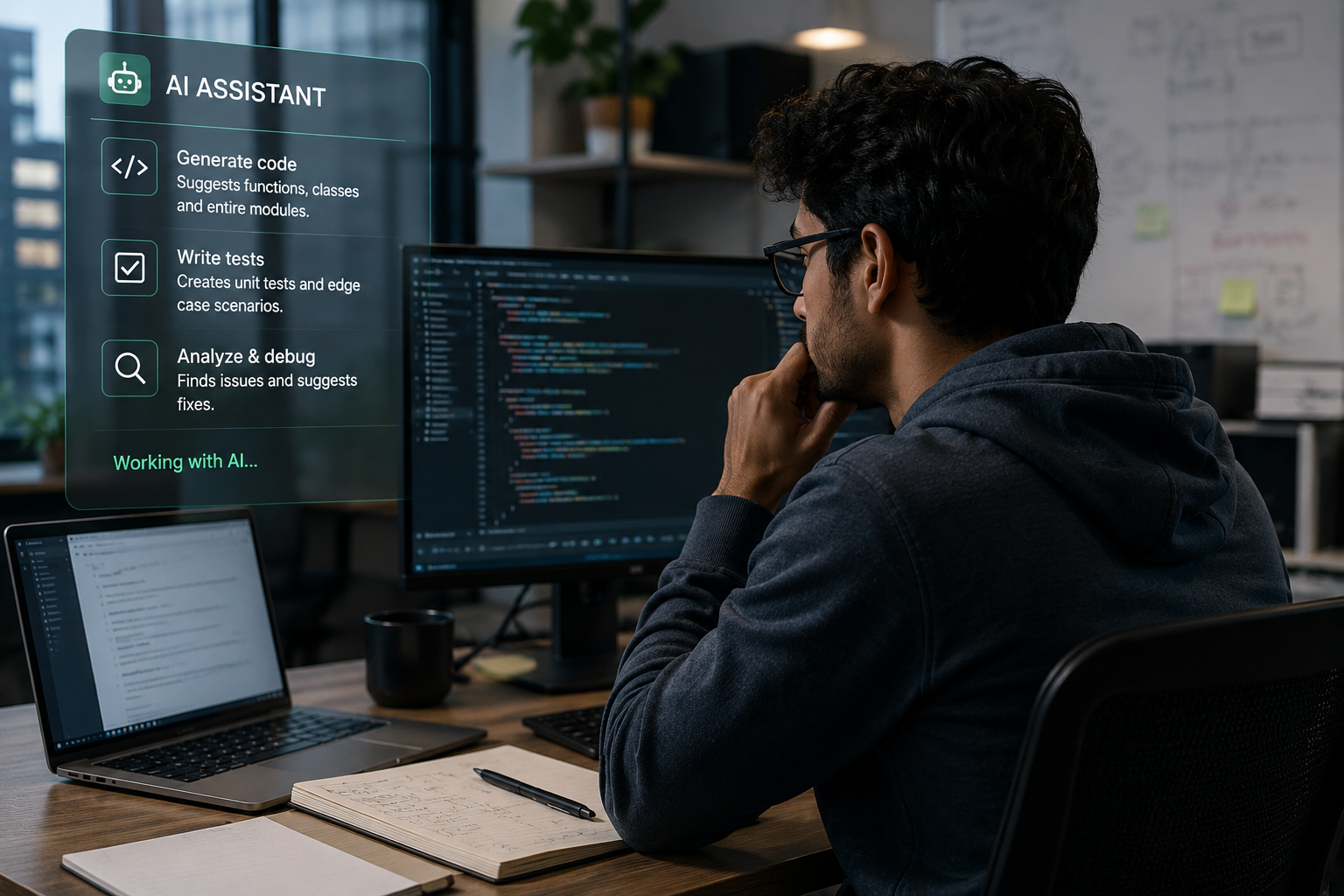
The AI Shift in Software Development
Why Developers Are Moving From Coding With AI to Engineering With AI
Artificial intelligence is no longer just a technology developers experiment with on the side.
It is becoming part of the software development process itself. From generating code and writing tests to analyzing documentation, debugging applications, and automating workflows, AI is already changing how developers approach their daily work. But the most important change is not that AI can generate code. The deeper change is that AI is becoming capable of participating in the workflow around the code.
This is where the next phase of AI development begins.
The industry is moving toward:
- Agentic workflows
- Stronger LLM security governance
- Enterprise AI integration
- Runtime safety
- Content provenance
- More efficient AI infrastructure
At the same time, one reality is becoming increasingly clear:
AI can automate many engineering tasks, but software engineering itself is much larger than writing code.
The future will not simply belong to AI systems or humans working independently. It will increasingly belong to developers who know how to combine human judgment with machine intelligence.
AI Is Moving Beyond Code Generation
For several years, AI coding assistants primarily focused on helping developers write code faster.
A developer could describe a requirement, and an AI model could generate:
- A function
- A component
- A database query
- An entire file
That was useful, but relatively limited.
Today, AI systems are increasingly connected to:
- Development environments
- Code repositories
- Documentation
- Testing tools
- APIs
- Databases
- Other software systems
This fundamentally changes developer interaction.
Traditional Workflow
Developer → Prompt → Code
Modern Agentic Workflow
Developer
      ↓
     Goal
      ↓
   AI Agent
      ↓
    Planning
      ↓
      Tools
      ↓
   Execution
      ↓
   Validation
      ↓
 Human Review
The AI is no longer simply producing text.
It is participating in the development process.
This is the foundation of Agentic AI.
What Are Agentic Workflows?
An AI agent does more than respond to one instruction.
It can:
- Understand a goal
- Break work into smaller tasks
- Use available tools
- Evaluate results
- Continue working toward completion
Example
Suppose a developer wants authentication added to an application.
A traditional assistant generates authentication code.
An AI agent could instead:
- Analyze the application
- Determine the authentication architecture
- Inspect project files
- Modify source code
- Generate tests
- Execute tests
- Detect failures
- Fix implementation
- Validate again
- Present results for human approval
The difference is significant.
The AI moves from code generation to task execution.
Developers are still responsible for:
- Requirements
- Architecture
- Security
- Business context
- Final approval
Automation reduces work—not responsibility.
AI Is More Likely to Change Developer Work Than Eliminate Developers
Writing code is only one part of software engineering.
Production software also requires:
- Architecture
- Security
- Infrastructure
- Testing
- Monitoring
- Performance optimization
- Debugging
- Product understanding
- Compliance
- Maintenance
- Decision-making
AI assists with many of these activities.
Assistance is not responsibility.
Example
An AI can build authentication for a banking application.
But engineers still decide:
- Is it secure?
- Does it satisfy compliance?
- Does it match business requirements?
Likewise:
AI may generate a SQL query.
Developers still determine:
- Is it secure?
- Is it efficient?
- Is it production-ready?
The key skill is changing from:
"Can you write code?"
to
"Can you understand problems, direct AI effectively, evaluate results, and build reliable systems?"
The Rise of LLM Security Governance
As AI systems become more capable, security becomes more complicated.
Traditional applications follow predictable instructions.
LLMs depend upon:
- Prompts
- Context
- Retrieved data
- External tools
- Model behavior
This introduces new risks.
Common AI Security Risks
- Prompt injection
- Sensitive information disclosure
- Unsafe tool execution
- Excessive permissions
- Malicious inputs
- Insecure third-party integrations
- Unauthorized actions
- Data leakage
These risks become even more serious when AI agents perform actions instead of simply generating text.
The important question becomes:
What is the model allowed to do?
This is the purpose of LLM Security Governance.
Security Must Cover the Entire Workflow
AI security cannot be implemented as a single protective layer.
Every stage requires protection.
User
   ↓
Prompt
   ↓
LLM
   ↓
Retrieval System
   ↓
Tools
   ↓
Database
   ↓
Action
   ↓
Output
Each stage introduces new risks.
Organizations must answer questions such as:
- Who can access the system?
- What information can the model retrieve?
- Which tools can it use?
- Which actions require approval?
- What data must never be exposed?
- How are model actions monitored?
- What happens when unexpected behavior occurs?
Runtime safety becomes essential.
Its goal is not preventing AI from acting.
Its goal is ensuring AI acts within clearly defined boundaries.
Enterprise AI Is Becoming Infrastructure
Businesses are moving beyond public chatbots.
Enterprise AI is now used for:
- Customer support
- Software development
- Knowledge management
- Document analysis
- Data analysis
- Enterprise search
- Workflow automation
- Business intelligence
- Operations
- Employee productivity
Enterprise AI must integrate with existing systems.
Typical architecture:
Application
      ↓
      API
      ↓
      LLM
      ↓
      RAG
      ↓
Vector Database
      ↓
Enterprise Data
      ↓
Security Layer
      ↓
 Monitoring
Developers increasingly require knowledge of:
- Software architecture
- APIs
- Databases
- Cloud platforms
- Identity systems
- Security
- Observability
- Deployment
AI engineering is becoming multidisciplinary.
Data and Context Matter
A powerful model alone does not produce a successful enterprise AI application.
Relevant information is essential.
This is why Retrieval-Augmented Generation (RAG) has become important.
Instead of relying only on training data, AI applications retrieve current organizational information before generating responses.
Examples include:
- Company policies
- Documentation
- Knowledge bases
This improves usefulness while introducing another governance challenge:
Who controls what the AI can retrieve?
Capabilities and security must evolve together.
AI Watermarking and Digital Trust
Generative AI creates realistic:
- Text
- Images
- Audio
- Video
This makes identifying original content increasingly difficult.
Technologies such as:
- Watermarking
- Content provenance
- Authenticity verification
help establish trust.
Their objective is transparency rather than labeling AI-generated content as good or bad.
As synthetic content grows, understanding content origin becomes increasingly important.
AI Infrastructure Is Becoming an Engineering Challenge
Behind every AI application lies significant infrastructure.
Large models require:
- Compute
- Memory
- Storage
- Networking
- Energy
Organizations increasingly focus on:
- AI accelerators
- GPU infrastructure
- Model optimization
- Faster inference
- Better memory utilization
- Distributed computing
- Model compression
- Energy efficiency
Better AI does not always mean larger AI.
Sometimes smaller, optimized models provide better engineering outcomes.
AI engineering is becoming an optimization problem.
Developers Need New Skills
Traditional programming remains essential.
Developers now benefit from learning:
AI Engineering
Understanding models and integrating them into applications.
Agentic Systems
Building workflows where AI plans, reasons, and uses tools.
RAG and Vector Databases
Connecting AI with enterprise knowledge.
AI Security
Understanding:
- Prompt injection
- Data leakage
- Permissions
- AI attack surfaces
Cloud and Infrastructure
Deploying scalable AI applications.
Evaluation
Testing AI reliability rather than assuming convincing responses are correct.
Governance
Defining:
- What AI can access
- What AI can do
- How AI behavior is monitored
These skills move developers from software creation toward engineering intelligent systems.
The Developer's Role Is Becoming More Strategic
As AI automates repetitive implementation:
- Architecture becomes more valuable.
- System design becomes more valuable.
- Security becomes more valuable.
- Problem-solving becomes more valuable.
- Business understanding becomes more valuable.
Engineering judgment is increasing in importance.
A developer who understands the right solution and effectively uses AI may deliver greater value than someone who only writes large amounts of code.
The skill is moving upward.
The Real Future: Human Judgment + AI Capability
The future is not humans versus AI.
It is humans working alongside AI.
AI Excels At
- Generation
- Automation
- Pattern recognition
- Repetitive work
- Analysis
Humans Remain Essential For
- Intent
- Judgment
- Responsibility
- Context
- Creativity
- Final decisions
The strongest engineering teams will combine both.
A modern workflow might involve:
- AI generating implementations
- AI testing software
- AI monitoring systems
- Humans reviewing and approving final decisions
This is not the elimination of software engineering.
It is the evolution of engineering workflows.
Conclusion
The AI landscape is moving beyond simple code generation.
The next stage focuses on building AI systems that can:
- Act
- Integrate
- Reason
- Retrieve information
- Use tools
- Operate within enterprise environments
Major trends include:
- Agentic workflows
- LLM security governance
- Enterprise integration
- Runtime safety
- Watermarking
- Content provenance
- Efficient AI infrastructure
The most important transformation, however, is the changing role of the developer.
The future is not:
AI versus developers.
The future is:
Developers who use AI effectively versus developers who do not.
The greatest advantage will belong to developers who combine:
- Engineering fundamentals
- AI capabilities
- Security awareness
- Human judgment
to build software that is faster, more reliable, more secure, and genuinely useful.
Share this post